Figuring out when to call a pro if your garage door won’t close can save you from costly repairs and keep your home protected. Not every problem is obvious, and some warning signs are easy to miss until the damage is already done.
This guide breaks down the exact signs that tell you it is time to stop waiting and call a professional garage door repair technician right away. The sooner you recognize those signs, the faster you can get your garage door working properly again.
Is It Always Safe to Wait Before Calling a Garage Door Professional?
No, it is never worth waiting when your garage door won’t close, because delaying a professional diagnosis almost always turns a manageable repair into a much more costly one.
Several reasons explain why waiting makes the situation worse:
- Worn springs and cables take on more load with every failed closing attempt and move closer to snapping
- Misaligned sensors left unchecked can disable the auto-reversal feature that protects people and property
- An opener that keeps running against resistance burns out its motor faster than normal
- Rollers and tracks under extra strain develop damage that spreads to other parts of the system
- Ignoring an intermittent problem gives it time to become a complete and costlier failure
To understand what triggers these issues from the start, read our guide on Why Garage Door Won’t Close, which covers the most common reasons homeowners in Castleton, IN, deal with this problem before it requires professional repair.
Common Reasons a Garage Door Won’t Close All the Way
Understanding why a garage door won’t close all the way is the first step toward getting the right fix from a professional.
Common reasons a garage door won’t close all the way include:
- Blocked or misaligned safety sensors interrupt the invisible beam and stop the door mid-cycle
- Incorrect travel limits tell the opener to stop before the door reaches the ground
- Bent or damaged tracks prevent the rollers from completing their full travel path
- Weakened springs or frayed cables can no longer guide the door all the way down
- Too much resistance detected by the opener triggers an automatic stop
Knowing which issue is behind the problem helps a technician resolve it on the first visit, and routine garage door maintenance keeps most of these causes from developing.
What to Check Before Calling a Garage Door Professional
Running through a few quick visual checks before calling a technician can help you describe the problem clearly and speed up the diagnosis process.
What to check before calling a garage door professional includes:
- Look at both sensors near the bottom of the door to see if the indicator lights are solid or blinking
- Wipe the sensor lenses with a dry cloth to remove any dirt, moisture, or cobwebs blocking the beam
- Check the tracks on both sides for visible dents, bends, or debris stopping the rollers from moving
- Press the wall button to see if the door responds differently than it does with the remote
- Pull the emergency release cord to check if the door moves freely when disconnected from the opener
These observations give a trained technician a clear starting point and reduce the time needed to find the root cause.
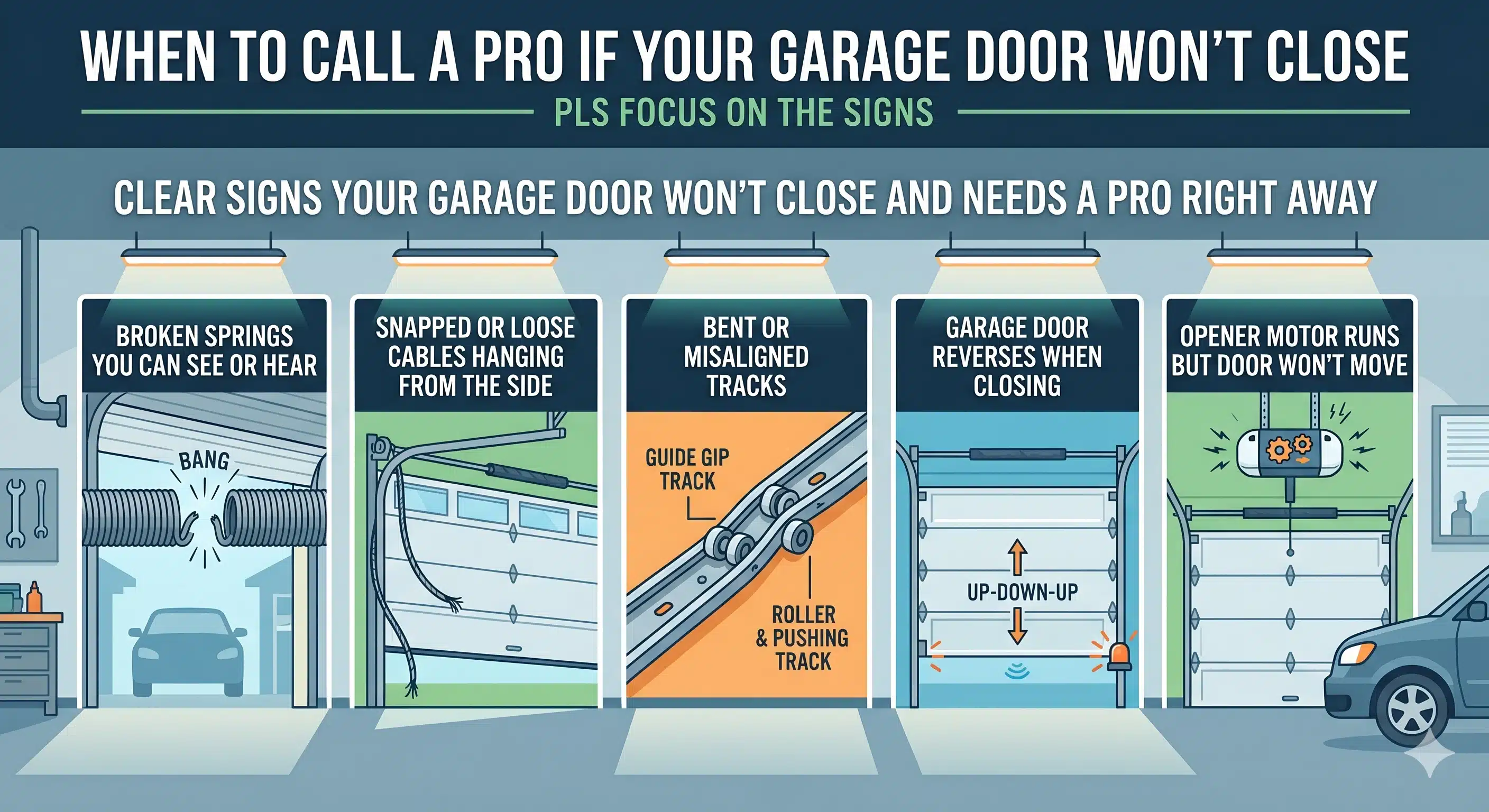
Clear Signs Your Garage Door Won’t Close and Needs a Pro Right Away
Broken Springs You Can See or Hear
Broken garage door springs are one of the most hazardous problems a homeowner can encounter, and a garage door won’t close properly when they fail.
Signs of a broken spring include:
- A loud bang from the garage signals that a torsion spring has snapped under tension
- Visible gaps in the spring coil above the door confirm it has separated and failed
- Manually lifting the door feels unusually heavy without functioning springs
- One side of the door sits lower due to uneven spring tension
- Running the opener with a broken spring forces the motor beyond its capacity
Continuing to operate the door with broken springs puts every connected component under abnormal stress, leading to further damage.
Snapped or Loose Cables Hanging From the Side
Cables work in direct coordination with the springs, and when one fails, the balance of the entire door is immediately compromised.
Signs of a cable problem requiring professional attention include:
- Frayed or kinked cable sections signal that a full snap is imminent
- Cables hanging loosely on either side have already detached from the drum
- One side of the door dropping faster than the other points to a lost cable tension
- Visible slack in a closed door means the cable is no longer under proper load
- Forcing the door closed with a damaged cable transfers full weight to the remaining hardware
Attempting to reattach or adjust cables without professional training puts the entire door system at immediate risk of collapse.
Bent or Misaligned Tracks
Even a minor bend or gap in the track is enough to stop the door from completing its full travel path safely.
Clear indicators of a track problem include:
- Visible bends or dents along the metal track confirm structural damage
- Gaps between the rollers and track show the door has left its intended path
- Grinding or scraping sounds point to rollers fighting against a damaged section
- Wobbling movement during travel signals that the track alignment is off
- Running the door on damaged tracks accelerates wear on rollers and panels
Bent tracks rarely return to their original precision without professional intervention and proper realignment tools.
Garage Door Reverses When Closing
A garage door reverses when closing, even without an obvious obstruction, because the system responds to a signal from a component that is no longer functioning correctly.
Reasons a garage door reverses during closing include:
- Misaligned safety sensors send a false obstruction signal, triggering an automatic reversal
- Oversensitive force settings cause the opener to treat normal resistance as a blockage
- Debris in the travel path activates the reversal feature as intended
- Incorrect travel limits make the opener register ground contact prematurely
- A malfunctioning opener board causes unpredictable reversals every closing cycle
Persistent reversals without a visible cause almost always indicate a component that needs professional recalibration or replacement.
Opener Motor Runs but Door Won’t Move
Hearing the opener motor run while the door stays completely still points to a disconnect between the drive system and the door itself.
Common causes behind this specific failure include:
- An accidentally pulled emergency release cord breaks the opener’s connection to the door
- Stripped internal gears allow the motor to spin without engaging the drive system
- Broken torsion springs create enough resistance that the motor cannot move the door
- Worn drive components in older openers lose their ability to engage under normal conditions
- Repeated operation against a blocked door strips the internal gears until full failure occurs
Running the opener repeatedly when the door won’t move turns a straightforward garage door opener repair into a full replacement.
How to Prepare Before the Garage Door Technician Arrives
Good preparation before the technician arrives helps the visit run smoothly and gets the diagnosis done faster.
Ways to prepare before the garage door technician arrives include:
- Write down when the problem started, and any sounds the door makes during operation
- Clear the area around the door so the technician has full access to all components
- Note whether the wall button and remote respond the same way or differently
- Have the opener brand, model, and installation year ready before the visit
- Leave the door in its current position so the technician can see the problem firsthand
Having everything ready before a possible garage door opener installation gives the technician a clear starting point and reduces the time spent on diagnosis.
What to Expect When a Professional Fixes Your Garage Door
A professional garage door repair visit follows a clear process from inspection to final testing, so nothing gets missed.
What to expect when a professional fixes your garage door includes:
- Full inspection of springs, cables, tracks, rollers, sensors, and opener before any repair begins
- Error codes and force settings are checked for irregularities affecting performance
- Repair options are explained clearly so the homeowner knows what needs to be done and why
- All garage door opener troubleshooting is handled by the technician without guesswork
- Travel limit settings and sensor alignment are recalibrated and tested before the job is complete
To walk through what each type of repair involves in detail, read our guide on How to Fix a Garage Door That Won’t Close, which covers the most common fixes a professional performs when a garage door wont close.
Factors That Affect the Cost of Garage Door Repairs in Castleton, IN
Knowing what drives repair costs helps Castleton, IN, homeowners set realistic expectations before the technician arrives.
Factors that affect the cost of garage door repairs include:
- The type and extent of damage determine the labor and time required
- Parts vary in price depending on the brand, size, and availability
- Older systems often require harder-to-find components that raise the overall cost
- Multiple worn components found during inspection add to the total scope of work
- Average cost may depend on whether the system can be repaired or needs full replacement
Getting a professional diagnosis early is the most reliable way to avoid a repair bill that grows as attention is delayed.
Regular Maintenance That Keeps You From Calling a Pro
Routine maintenance is the most effective way to keep a garage door closing properly and avoid an unexpected service call.
Maintenance habits that keep you from calling a pro include:
- Wipe sensor lenses monthly to prevent dirt and cobwebs from blocking the beam
- Check both sensor indicator lights every few months to catch alignment issues early
- Lubricate rollers, hinges, and tracks regularly to reduce friction and premature wear
- Inspect cables and springs for fraying, rust, or uneven tension before problems develop
- Schedule a professional garage door service visit at least once a year
To get a full preventive maintenance plan that keeps your garage door closing consistently, read our guide on How to Prevent a Garage Door From Not Closing, which covers everything homeowners can do to avoid recurring closing problems.
Call a Pro the Moment Your Garage Door Won’t Close
A garage door wont close when something inside the system has already reached the point where professional diagnosis is the only way to find the root cause. Recognizing the right moment to call a pro is what keeps a manageable repair from turning into a full system replacement.
Affordable Garage Door Repairs of Castleton proudly serves homeowners throughout Castleton, IN, with professional garage door repair services focused on accurate diagnosis and lasting results. Contact us or give us a call today, and let our trained technicians determine exactly when and why your garage door won’t close.