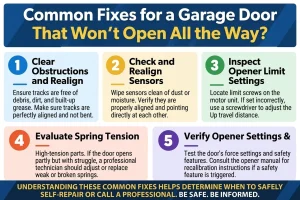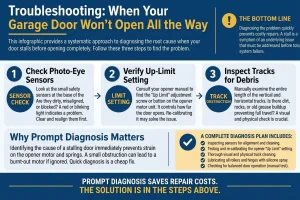

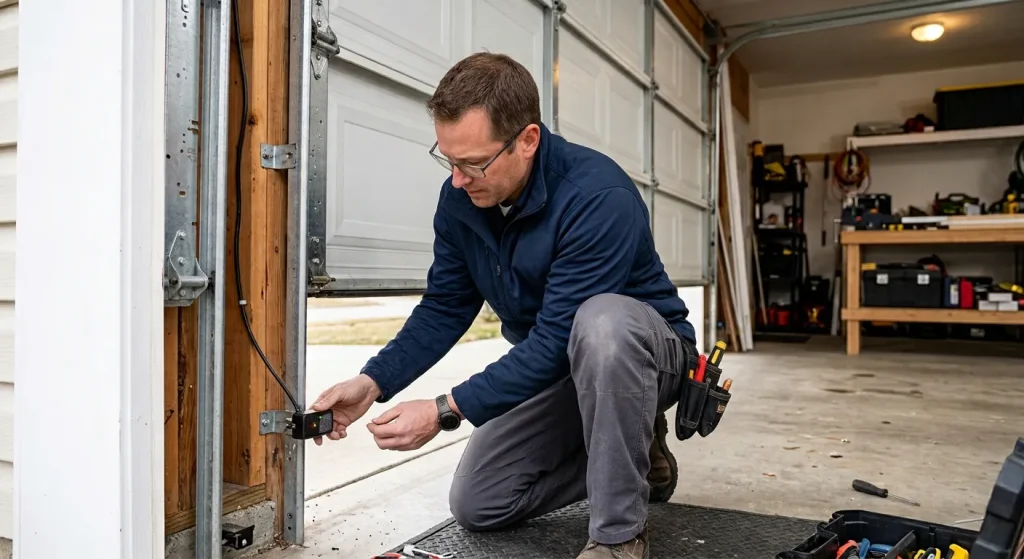
Garage door sensor lights are misaligned when one sensor is at a different angle or height than the other, causing the infrared beam between them to break rather than connect properly. This often shows up as a blinking light or a garage door that reverses before closing, both signs that a garage door repair may be needed soon.
These visual signs provide a quick way to confirm misalignment without needing any tools or prior technical knowledge. A garage door sensor that appears slightly tilted, physically shifted, or pointed away from its matching unit is almost always the reason behind inconsistent readings and failed closing attempts.
How Sensor Misalignment Affects Garage Door Performance
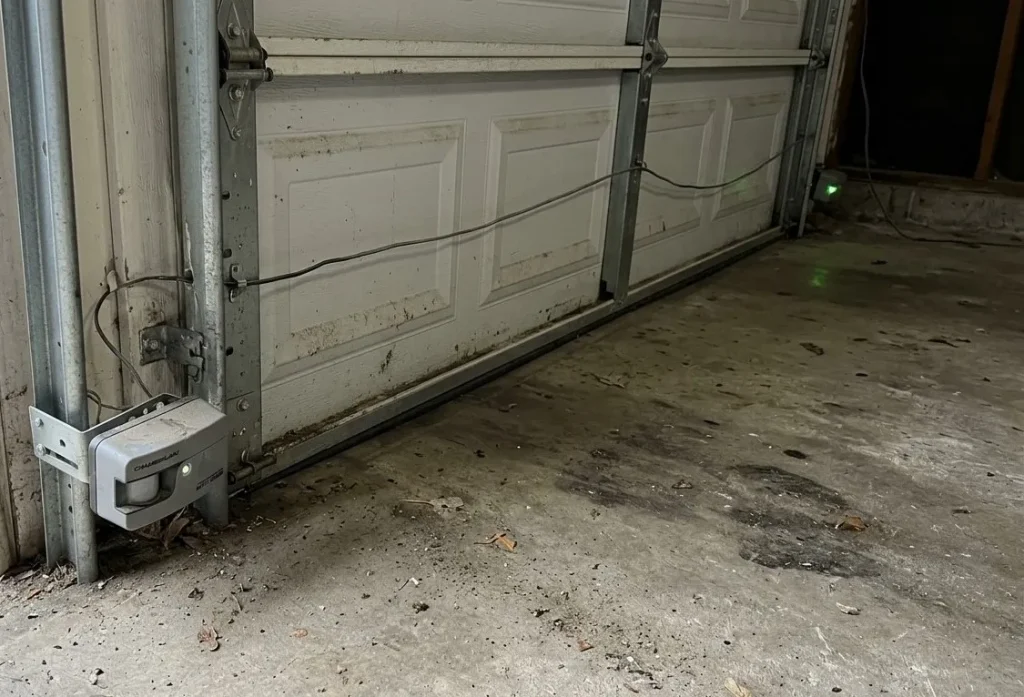
change color or shut off when the beam connection between the two units is disrupted, and that disruption often first appears as a change in the entire garage door system’s performance.
Common ways misalignment affects garage door performance include:
- The door refuses to close and stops partway through the cycle.
- The closing motion starts, then reverses back up without warning.
- Remote and wall commands receive slow or inconsistent responses from the garage door opener.
- Holding down the wall button becomes the only way to force the door closed.
- Repeated open-and-close cycles occur without ever completing a full close.
To see how these performance issues tie back to sensor light color, read our guide on Should Both Lights Be Green on Garage Door Sensors?, which breaks down what each color means for the connection.
5 Signs of Misaligned Garage Door Sensor Lights
Flashing or Off Indicator Lights
A blinking or unlit sensor light means the beam connecting both units has lost its signal somewhere along the path.
Several light patterns are worth paying attention to:
- One sensor holds a steady light while the other blinks without stopping
- Both lights go dark the moment the door starts its closing cycle
- A light that was working fine yesterday now flickers with no clear trigger
- Tapping or nudging the sensor housing briefly changes the light behavior
- The blinking pattern shows up only when the garage door is in motion
A technician performing a garage door opener repair checks the indicator light behavior first, since it points directly to where the connection is breaking down.
Door Reverses When Closing
Stopping and reversing partway through the closing cycle means a garage door is reacting to a safety beam it can no longer detect properly.
Reversal tends to follow a noticeable pattern:
- The door stops at roughly the same height every time before reversing
- Reversal happens instantly, without any pause or hesitation first
- The opener motor changes pitch right before the door moves back up
- Both the remote and the wall switch trigger identical reversal behavior
- Several attempts in a row end with the same reversal pattern
Landing at the same reversal point in every cycle signals exactly where that beam connection keeps breaking down.
The Wall Button Only Works If Held Down
Needing to hold the wall button down means the opener is bypassing its own safety circuit instead of confirming a clear beam.
Checking the brackets often reveals telltale clues like these:
- Letting go of the button, even briefly, stops the door in place
- The remote control produces the exact same stalled behavior
- Holding the button results in a noticeably slower close
- The workaround only appears on closing, never on opening
- Family members start relying on the hold-down habit without questioning it
Older setups from a prior garage door opener installation are more likely to develop this bypass behavior as wiring and components age.
Opener Light Blinks 9 to 10 Times
A repeated 9- to 10-count on the opener’s overhead light is a built-in signal on many systems, flagging a sensor problem.
Certain details help confirm the pattern is meaningful:
- The same blink count repeats across several closing attempts
- Blinking begins immediately after a failed or interrupted cycle
- No visible obstruction is present when the blinking occurs
- The count stays identical whether using a remote, keypad, or wall switch
- A full, uninterrupted cycle resets the blinking until the next failed attempt
Counting the exact number of blinks turns a vague error into a specific clue worth mentioning during a service call.
Sensors Are Visibly Tilted or Facing Different Directions
A visible gap in the sensor direction is one of the easiest signs of misalignment a homeowner can catch without any tools.
Checking the brackets often reveals telltale clues like these:
- One sensor bracket sits lower or higher than its matching pair
- A sensor faces slightly outward instead of directly across the track
- Mounting screws look loose or backed out of the bracket
- The angle no longer matches how the unit was originally installed
- A small nudge to the bracket instantly changes the sensor’s light status
Sensors can get bumped out of position during a garage door replacement or other work near the track, which makes a quick angle check worthwhile afterward.
What Garage Door Sensor Light Colors Reveal
Each sensor light color indicates a different stage of connection between the two units, from a solid confirmation to a warning that the beam is being interrupted.
Light Color | What It Usually Means |
Solid green on both sensors | The beam connection is working properly |
Green on one, dark or flickering on the other | The beam is broken or interrupted |
Garage door sensor yellow light | A partial obstruction is likely sitting on the lens |
Garage door sensor orange light | Sunlight interference may be affecting the signal |
Alternating or unstable colors | A loose connection rather than a full break |
To trace how these color changes develop in the first place, read our guide on What Causes Garage Door Sensor Lights to Change Color?, which breaks down the most common triggers behind each shift.
How to Confirm It’s Actually a Sensor Misalignment
A true misalignment can be confirmed by ruling out the other issues that often mimic the same symptoms before assuming the sensors themselves are the problem.
A few quick checks help confirm the cause:
- Both sensors receive power and show some form of indicator light
- The lenses are clean and free of dirt, dust, or spider webs
- No boxes, tools, or stored items block the beam path
- The door reverses consistently at the same point every time
- Wiring at the sensor terminals looks secure and undamaged
To work through these checks in more detail, read our guide on What to Check When Garage Door Sensor Lights Change Color, which walks through each step for narrowing down the actual cause.
Why Sensor Realignment Should Be Left to a Professional
Sensor realignment demands a level of precision that goes beyond a quick adjustment, which is why the task carries more risk than it appears to at first glance.
A few reasons professional handling matters most:
- Precise angle adjustments are difficult to achieve accurately by eye
- Incorrect realignment can create new sensor issues instead of solving one
- Diagnosing the true cause requires experience with multiple garage door systems
- Garage door sensor repair cost often depends on getting the diagnosis right the first time
- Improper handling can affect the safety feature that the sensors are meant to provide
Leaving realignment to a trained technician reduces the chance of turning a simple fix into a repeated problem.
How Professionals Realign Garage Door Sensors
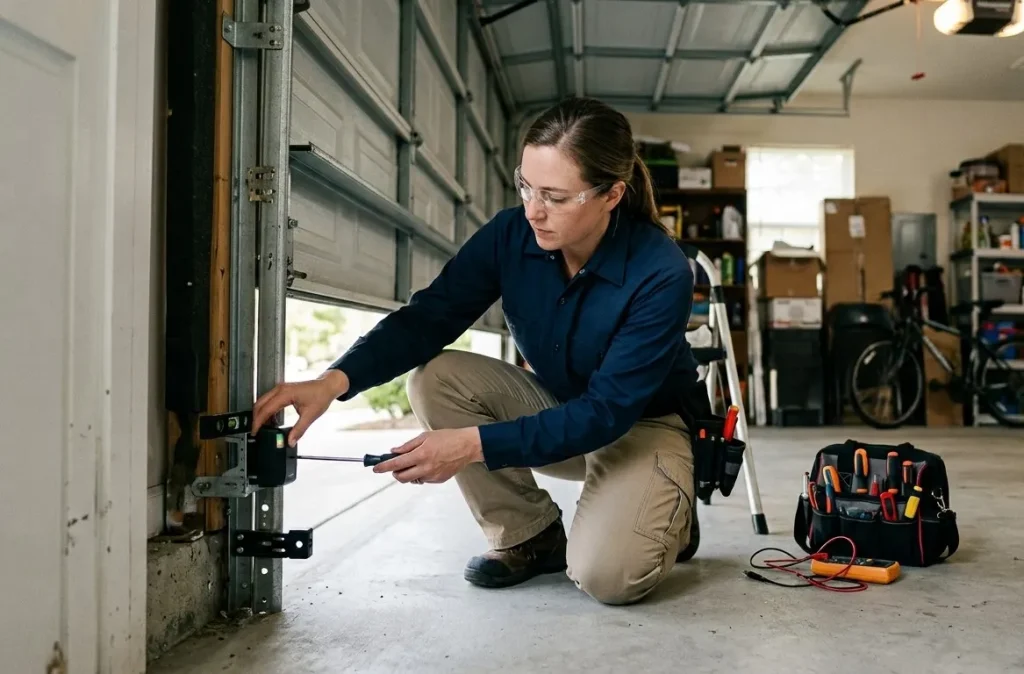
A professional garage door technician follows a consistent process to restore proper alignment without risking further damage to the system.
The process typically includes these steps:
- Inspecting sensor brackets, wiring, and lens condition first
- Adjusting each sensor’s angle in small, deliberate movements
- Confirming a solid green light appears on both units
- Testing the door’s reverse function multiple times before finishing
- Verifying the fix holds after several full open and close cycles
Following this structured process helps confirm that the alignment is fully restored rather than only temporarily improved.
Trust a Professional to Restore Alignment to Garage Door Sensor Lights
Garage door sensor lights communicate a lot through color, blinking patterns, and how the door reacts during daily use, and recognizing these signals early makes it easier to spot a shift out of place. A quick check of both sensors can often confirm whether a true misalignment is the actual cause.
Affordable Garage Door Repairs of Castleton works with homeowners throughout the area to resolve sensor issues ranging from simple lens cleaning to full sensor replacement. Contact us or give us a call today, and let the team confirm what the sensors need to be realigned.